-
5 Essential Tips to Avoid Injury During the New York City Marathon
As the excitement builds for the upcoming New York City Marathon, runners from around the world are gearing up for this iconic race. To ensure a safe and injury-free experience, we have compiled five essential tips for marathon participants to follow during race week and on race day.
1. Fuel with Carbs: Be sure to eat plenty of carbohydrates in the days leading into the race. A common approach to healthy ‘carb loading’ is to eat 10% more carbs per meal for all meals leading into the race, starting three days prior to. These should all be carbs you are used to eating.
2. Eat a Balanced Pre-Race Meal: Getting up extra early to allow time for a full breakfast (with the additional 10% carbs mentioned above) can help provide the energy storage needed for later in the race. Do allow for an extra 30 minutes to digest as often times things might not work as ‘smoothly’ given the race day excitement.
3. Warm-Up Properly: Before the race, engage in a dynamic warm-up to prepare your muscles and joints. If you are having to stand around for 10 or 20 minutes in your corral (or longer), save your energy and stay relaxed. Wear an extra ‘throw away’ layer to stay warm and then only start doing light dynamic stretches 2-3 minutes before you start.
4. Be Comfortable with the Crowd: For big races the first couple miles may be a bit of logjam. Try not to use too much energy trying to circle around folks in front of you. The slower pace at the start will only help save energy for the second half of the race.
5. Listen to Your Body: Pay attention to any signs of discomfort or tension in the days leading into the race. There is no harm to hitting the foamroll and doing a bit of extra stretching to address any minor soft-tissue sensations, particularly if they are asymmetrical.
By following these tips, runners can enhance their performance and enjoy a safe marathon experience. We wish all participants the best of luck in the New York City Marathon!
About the Author

Joseph McConkey, MS, is a running coach and exercise physiologist, specializing in injury prevention. He has worked with the full spectrum of running athletes, from first-time runners, to marathoners around the world, to Olympic athletes at the elite high altitude training camps of Ethiopia and Kenya. He has coached at the club, college, and pro levels and have been the director of the Boston Running Center’s Gait Analysis Lab for more than a decade. Joseph holds the highest accreditation by the USA Track and Field Association and the IAAF, as well as a Masters in Exercises Science with a focus on Injury Prevention and Sports Performance. He is the author of Pliability for Runners.

PLIABILITY FOR RUNNERS
Written by Joseph McConkey, MS
978-1-57826-910-5, $16.95 paperback
978-1-57826-911-2, $9.99 ebookPublished by Hatherleigh Press.
Distributed through Penguin Random House.
Available wherever books are sold.
www.hatherleighpress.com -
8 Running Moves to Keep Legs Loose & Responsive
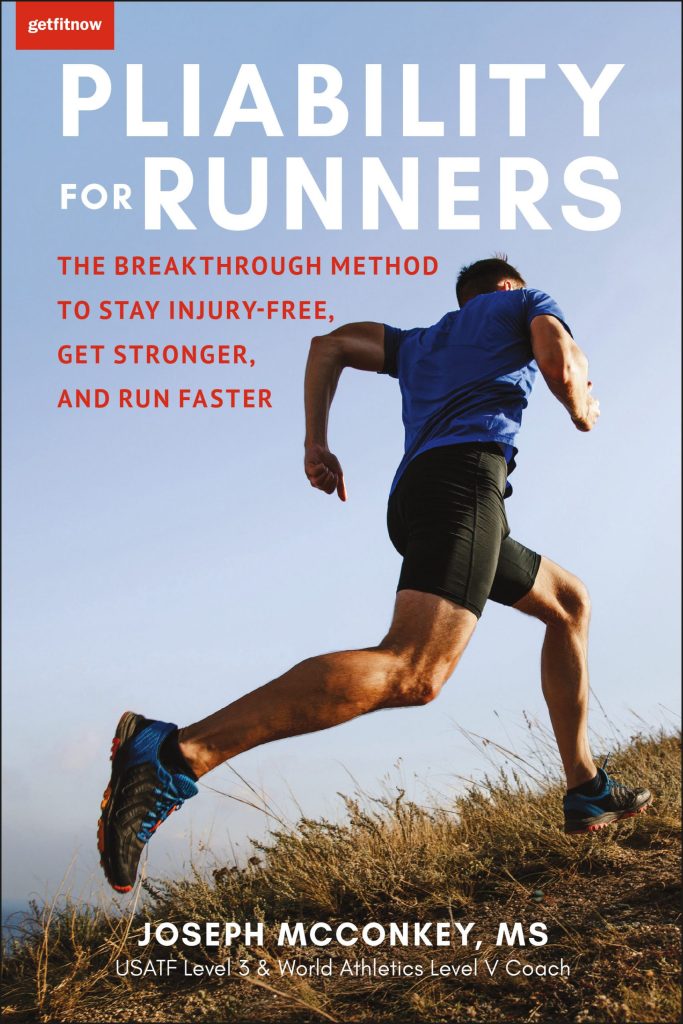
Often runners feel great during a hard workout, take the next run easy, perhaps a second run easy, and then attempt another hard workout. For this second hard run, though, they feel less crisp, not as light on their feet, and the results and therefore motivation suffer. The reality of this situation is that the cardiovascular and metabolic systems may very well have adapted to the first hard workout, however, inadequate attention to the musculo-skeletal system may have prevented these increased efficiencies from coming to fruition.
To ‘connect’ these runs, or reproduce the ease of motion and speed felt in one workout with the next, many things can be done. First is of course the standard recovery tactics like stretching after the runs, getting sustenance soon after the workout, taking an ice bath or foam rolling key areas of stress as needed. All paramount and should be standard for those able to work to high levels of exertion during training. Along with these tactics, however, let’s add in a few techniques to ensure the muscles, tendons, ligaments, and fascia are remaining supple, strong, and flexible during the recovery process and the recovery runs.
The following suggestions are based on standard drills and stretch positions. These are to be done while running and involve simply altering your stride slightly for 3-6 steps at a time, then repeating as desired. There are certainly more to be found so be creative and look for your own ‘secret steps’ to keeping your legs loose and responsive.
1. Butt-kicks: A controlled pull of your foot towards your glutes during the flight phase and done by primarily flexing at the knee. When done during a run this standard drill can be done with one leg at a time and with as many regular strides in between.
2. Foot-flicks: A controlled snap of your foot forward done right before the foot hits the ground and accomplished with a quick contraction of the quadriceps, this resulting in a very brief full extension (straightening) of the leg.
3. Side-steps: Slightly rotate one leg outwards by having the foot facing more towards the side than straight ahead.
4. Pigeon-steps: Very slightly rotate one leg inwards by having the foot facing more inwards than straight ahead.
5. Cross-overs: Have the feet cross over each other when landing.
6. Bowlegged-steps: Run as if a small stream of water is directly underneath you and right along your path, i.e. so that your steps have to be 4-8 inches wider apart than normal.
7. Carioca or grapevine: Running sideways by first having the right leg cross in front of the left and then behind.
8. Backwards running: Plain and simple.
Only runners 100% healthy should explore and work with these techniques. For those with right and left strength or flexibility imbalances these can be quite helpful but more caution should be taken. Given the initial awkwardness of these movements be sure to do this on a flat, obstruction free area.
If you want to know more about how to run smarter and better, check out my book Pliability for Runners.
About the Author
Joseph McConkey, MS, is a running coach and exercise physiologist, specializing in injury-prevention. He has worked with the full spectrum of running athletes, from first-time runners, to marathoners around the world, to Olympic athletes at the elite high altitude training camps of Ethiopia and Kenya. He has coached at the club, college, and pro levels and has been the director of the Boston Running Center’s Gait Analysis Lab for more than a decade. Joseph holds the highest accreditation by the USA Track and Field Association and the IAAF, as well as a Masters in Exercises Science with a focus on Injury Prevention and Sports Performance. He is the author of Pliability for Runners.
-
Pliability for Runners – The Breakthrough Method to Stay Injury-Free, Get Stronger and Run Faster
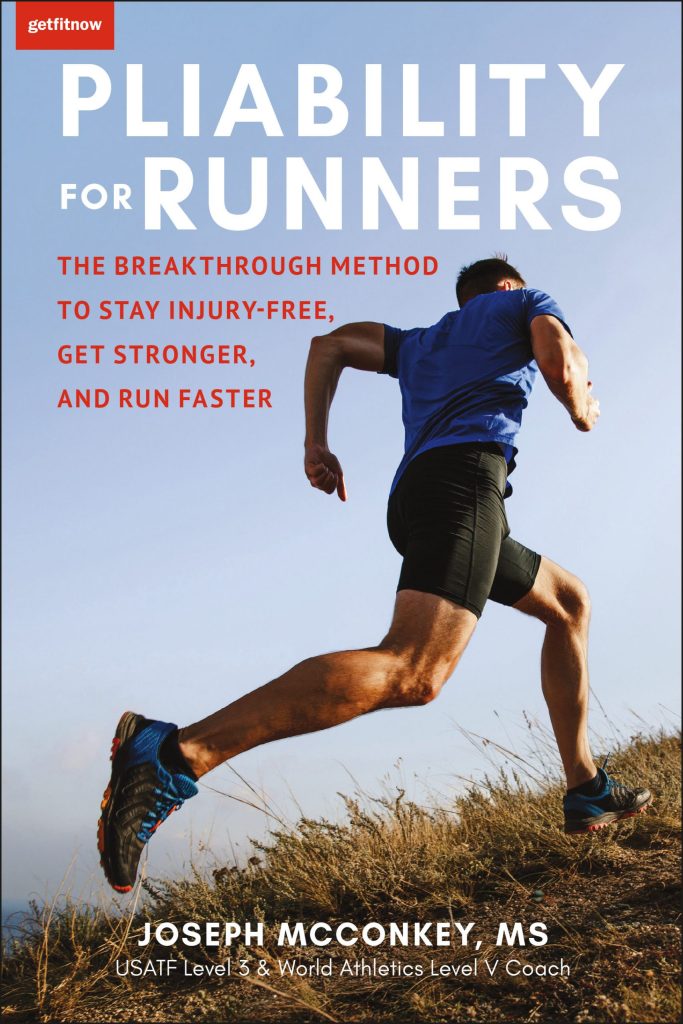
With over dozens of exercises and sport-specific workout plans—all backed by modern, field-tested science—Pliability for Runners is the key to achieving optimum athletic performance while breaking the injury cycle.
Recreational runners, cross country and track runners, competitive road racers and professional athletes across the globe understand the critical importance of taking proper care of your body. Without proper upkeep, muscle fatigue, repetitive motion injuries and the general wear-and-tear of day-to-day living takes its toll on our body, making it less coordinated, more restricted and less responsive to the demands of athletic activity.
Pliability for Runners changes all that. By offering a complete and thorough breakdown of improving your body’s pliability, runners of all skill and experience levels can take advantage of increased flexibility, stronger muscle resilience and better performance during (and after) workouts.
Pliability for Runners also features targeted stretches and exercises perfect for every fitness level, helping to improve the following: muscle strength, range of motion, explosive power, chronic muscle tension, endurance, and flexibility.
About the Author
Joseph McConkey, MS, is a running coach and exercise physiologist, specializing in injury-prevention. He has worked with the full spectrum of running athletes, from first-time runners, to marathoners around the world, to Olympic athletes at the elite high altitude training camps of Ethiopia and Kenya. He has coached at the club, college, and pro levels and has been the director of the Boston Running Center’s Gait Analysis Lab for more than a decade. Joseph holds the highest accreditation by the USA Track and Field Association and the IAAF, as well as a Masters in Exercises Science with a focus on Injury Prevention and Sports Performance.
You May Also Like

Little Box of Happy – My Little Mascara Club